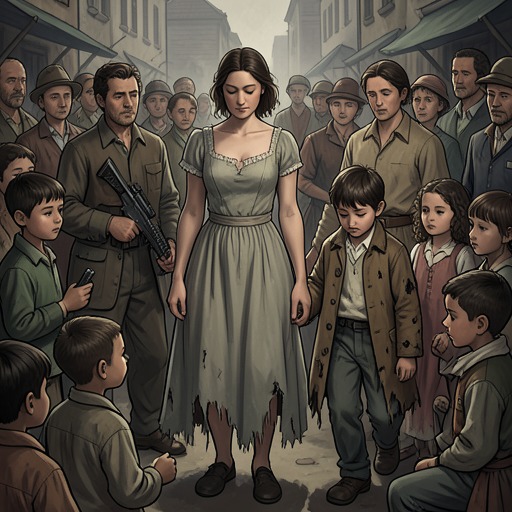
Bénédicte marries Jean-François
L'Amour et les ForêtsBénédicte marries Jean-François in the aftermath of her first marriage’s collapse, when depression and fear of solitude have left her especially vulnerable. Her twin sister, Marie-Claire, remembers the courtship’s hidden beginnings and the family’s alarm: the marriage that followed was not, in her account, the realization of an established love, but a bond formed under circumstances that Bénédicte would spend the next thirteen years trying to escape.
Background and Hidden Beginnings
The marriage’s origins reach back to the period after Olivier abandoned Bénédicte. Jean-François was part of the family and had known her since childhood, but Marie-Claire recalls that Bénédicte had not previously regarded him as a romantic partner. In her view, the two were markedly unlike one another, and Jean-François had never occupied the place in Bénédicte’s life that Olivier had held. Their apparent familiarity concealed no obvious courtship to the family: they were often together with Marie-Claire and her husband, Damien, while Jean-François continued to sleep at his parents’ home.
In April 1993, Marie-Claire unexpectedly saw Bénédicte and Jean-François kissing on a sofa in their parents’ house. She was shocked, and the encounter left Bénédicte visibly embarrassed. Marie-Claire did not question her sister afterward; she thought Bénédicte might feel ashamed and saw that she was avoiding her. At the time, she could not tell whether the kiss reflected a new attachment or simply Bénédicte’s need for comfort during depression. That uncertainty later became a source of regret: Marie-Claire believed she might have been able to ask what was happening, listen, and warn her sister before the relationship became a marriage.
Jean-François’s feelings, however, were not new. When Olivier left Bénédicte, Jean-François was traveling in Italy and phoned the family for news. After Marie-Claire told him that Bénédicte had been abandoned and was returning to her relatives, he responded with joy. He explained that he had wished for the couple to separate and had thrown coins into the Trevi Fountain while making that wish. For Marie-Claire, this call revealed how intensely he had wanted Bénédicte to become available to him, even as she was reeling from the end of her marriage.
The Decision to Marry
By June, Bénédicte told her mother, in Marie-Claire’s presence, that she and Jean-François planned to travel to Tuscany together in July. The announcement made their relationship unmistakable to the family. Marie-Claire was devastated; she understood the trip as the public confirmation of a couple she feared was badly mismatched. Her father had also expressed concern when they married six months after the kiss, describing the decision as too hurried.
Marie-Claire later went to a psychiatrist because she could not understand why Bénédicte would choose Jean-François. She came to see her sister’s decision in relation to Bénédicte’s difficulty imagining a life without a dependable emotional bond. On their wedding day, Bénédicte spoke to her briefly about the marriage: Jean-François had made a proposal, and she had followed him. Marie-Claire understood that, in Bénédicte’s fragile state, the prospect of remaining alone for years felt beyond her strength. This recollection supplies the event’s starkest explanation, while leaving the decision Bénédicte’s: she accepted the offer at a moment when companionship seemed necessary to endure.
Unequal Expectations
Marie-Claire distinguishes her own marriage from her twin’s. She describes her relationship with Damien as a lifelong attachment in which friendship, love, and partnership had grown together. Bénédicte’s marriage, by contrast, began with a need for emotional dependence rather than, in Marie-Claire’s judgment, an existing love for Jean-François. She believed Bénédicte could tolerate solitude in everyday life so long as she was not alone in the larger sense of having no one to depend on. Marriage gave her that attachment, but it also prompted her to imagine, after the fact, that the couple had been united by a love that might eventually develop.
In Marie-Claire’s account, Bénédicte’s hope that love would emerge became entangled with the wish to believe in a successful marriage and an accomplished family life. The distinction between an initial fiction and a lived reality blurred over time: Bénédicte could treat the belief in their love as the foundation of the life she was trying to build, even when disappointment persisted. Marie-Claire says that this idealized account helped conceal from her how much Jean-François hurt her sister. The wedding therefore marks not only a commitment but also the beginning of a story Bénédicte needed to tell herself in order to inhabit that commitment.
Consequences and Retrospective Meaning
Later events expose the imbalance that Marie-Claire sees in the marriage’s beginnings. Bénédicte tells Christian that her husband expects to know where she is, has her schedule, and can reach her through the home telephone; she describes being tracked while also minimizing the restrictions on her freedom. After her afternoon with Christian, Jean-François repeatedly questions and accuses her, including interrupting her sleep to demand further explanations. When, years later, he discovers affectionate messages on a hidden second phone, he reacts with rage and pushes her against a wall; Bénédicte tells Éric that this is the first time he has physically attacked her. During her cancer treatment, Marie-Claire also finds that Jean-François controls her prescriptions and prepares her medication, a dependence she urges Bénédicte to resist.
These later episodes do not change what happened at the wedding, but they sharpen its significance in retrospect. Marie-Claire understands the marriage as having formed at a moment when Bénédicte was hurt, isolated, and receptive to the security of being chosen. Jean-François, in her interpretation, saw that vulnerability as an opening. She traces the couple’s later misery to those conditions of formation and describes Bénédicte’s long struggle to free herself from the relationship. The marriage thus begins as an answer to the fear of being alone and becomes a lasting structure from which Bénédicte finds it difficult to recover her independence.